 About RSN Stitch Bank
 point de Cordova
- Cordova stitch
- veined points
- veined pyramids

Point de Cordova weaves thread around the intersection of a net ground to form a raised woven triangle. Historically, it is worked as part of the guipure d’art tradition, but it could be worked on a cutwork grid or even a trellis. Thérèse de Dillmont indicates that it can be worked between gridlines by wrapping the thread vertically to create a central line - see the image at the end of the entry for a diagram.
The stitch first appears in print in 1870 when it features in Beeton’s Book of Needlework. The origin of the name is unclear, but presumably references the city of Cordoba in southern Spain.


Point de Cordova is generously sponsored by Diana Stephenson
Method


Bring your thread up in the bottom right hole and then slide it under the top central gridline from left to right.

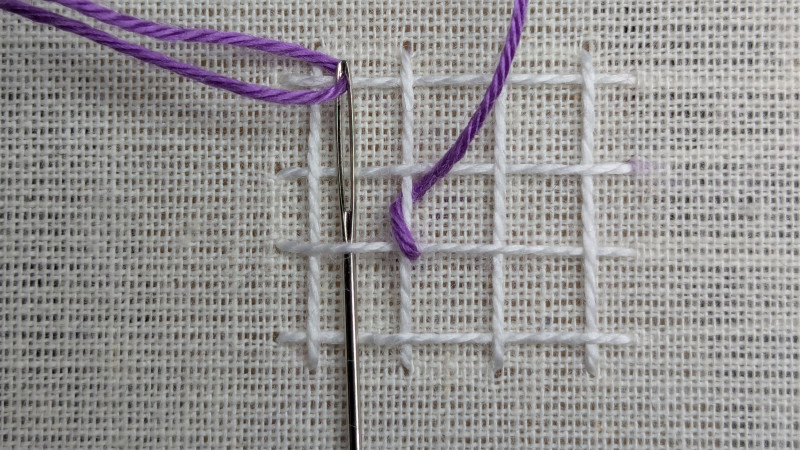
Wrap it around the central gridline and then slide it under the left horizontal gridline from top to bottom.


Bring your thread up in the bottom left hole and then slide it under the top central gridline from right to left.


Wrap it around the central gridline and slide it under the right horizontal gridline from top to bottom.


Continue wrapping the thread in this way, alternating the left and right sides around the central gridline to build up a triangle.


Finish by sliding the needle through the base of the point de Cordova and cutting the thread.
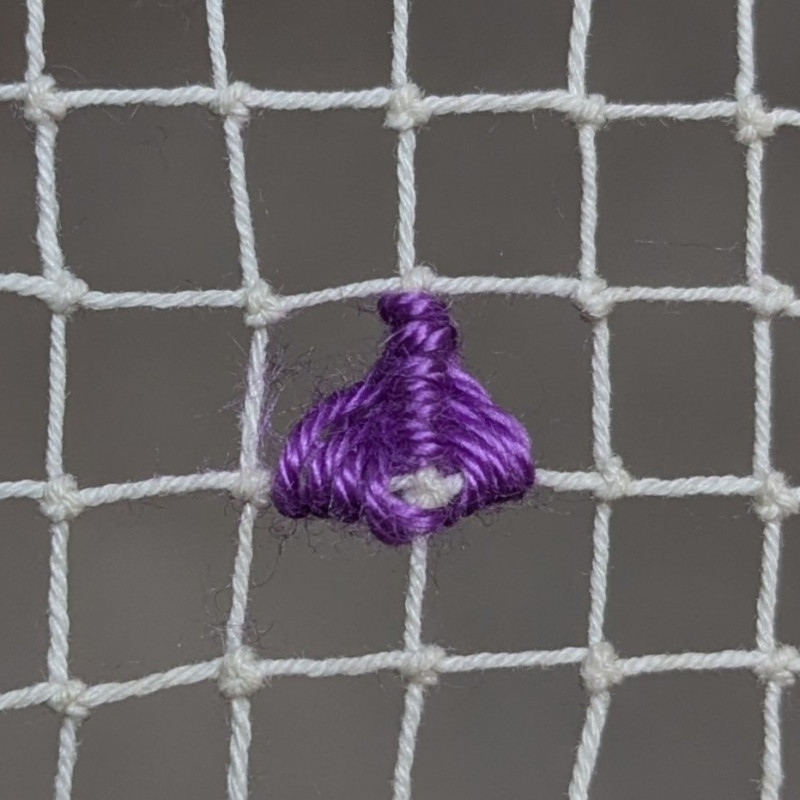
The reverse of point de Cordoba.
 point de Cordova
Structure of stitch
Common uses
Embroidery Techniques
Identifying point de Cordova
This stitch can be identified by the woven triangle which it forms. The front shows the threads alternately overlapping in the centre to form a solid area; the reverse shows the threads being whipped around the centre which resemble one of the spokes from a whipped wheel.
References
Examples of point de Cordova

Thérèse de Dillmont’s veined points
Thérèse de Dillmont's Complete encyclopedia of needlework shows the stitch worked between gridlines.