 About RSN Stitch Bank
 Plush stitch
- Velvet stitch
- Raised stitch

This canvaswork stitch consists of a tent stitch followed by a loop on the surface of the canvas which is anchored by a gobelin stitch. The loops can either be cut to form a piled surface or left as loops.
Plush stitch certainly dates to the late 19th century as it features in Caulfeild and Saward’s 1882 Encyclopedia of needlework. In this period plush stitches were used as part of Berlin wool work where they were often used to portray large flowers or animals, shaded in different colours and then trimmed to reflect the shape of the motif.
 Looped
 Piled
Piled
 Embellishment
 Filling
 Shading
 Canvaswork
 Rug-making
Turkey rug knot
Rug-making
Turkey rug knot
 Short pile stitch
 Short pile stitch (variation 1)
 Short pile stitch (variation 2)
 Single knotted stitch
 Velvet stitch
 Surrey stitch

In honour of Donna Pence
for her service to the
Embroiderers’ Guild of America
Mid-Atlantic Region
Method


Start at the base of the design with a single tent stitch.

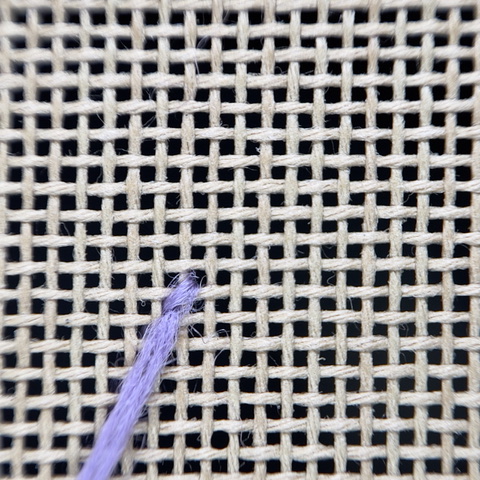
Bring the needle up where the tent stitch started.

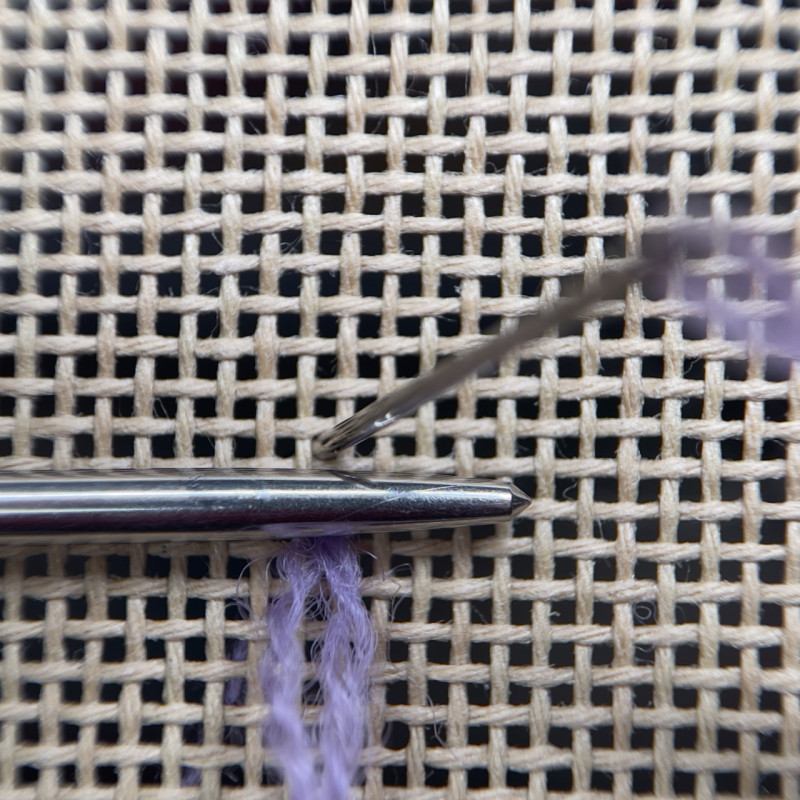
Lay a size 4 knitting needle over the tent stitch and make a straight stitch above, taking the thread down over the knitting needle and two threads of the canvas.

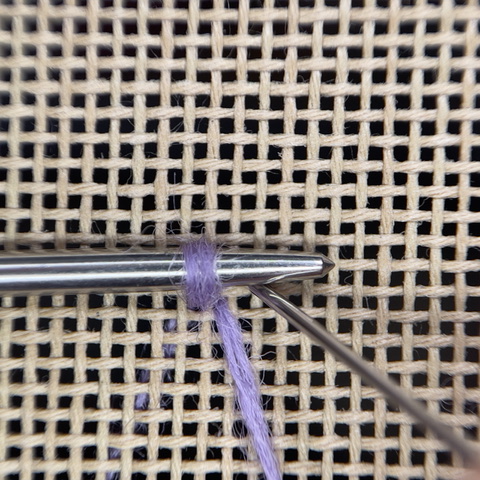
Make another tent stitch adjacent to the first.

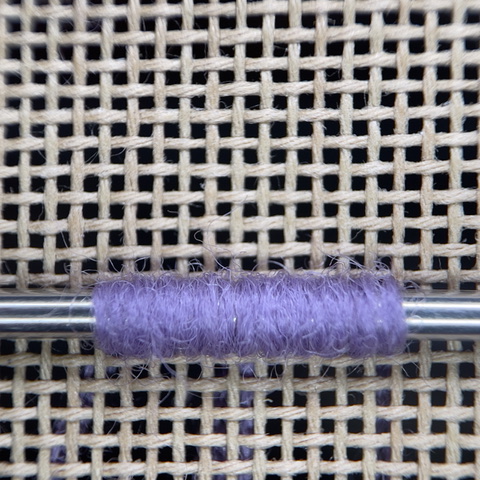
Repeat the sequence to complete the row.


The next row is worked directly above and the knitting needle is left in the lowest row until the row above is completed, this prevents any surface wool being dragged to the back.


Remove the knitting needle from the first row to commence the next row.


Cut and comb the loops once the stitching is complete.

 Plush stitch
Common uses
Embroidery Techniques
Variant Stitches
Related Stitches
Identifying Plush stitch
This piled stitch can be identified by the parallel rows of either loops or cut pile. Depending on the gauge of the canvas and the thickness of the thread, the canvas may be visible between the rows.